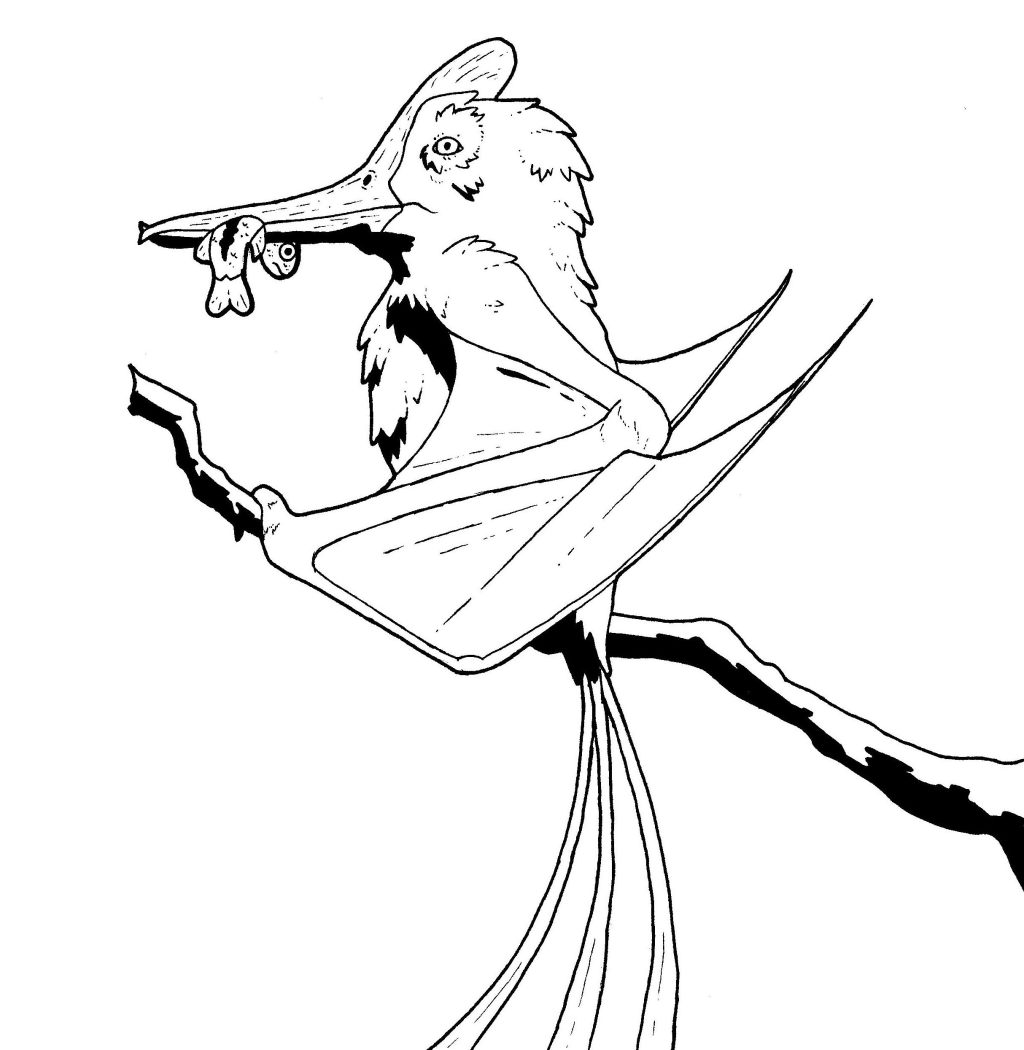

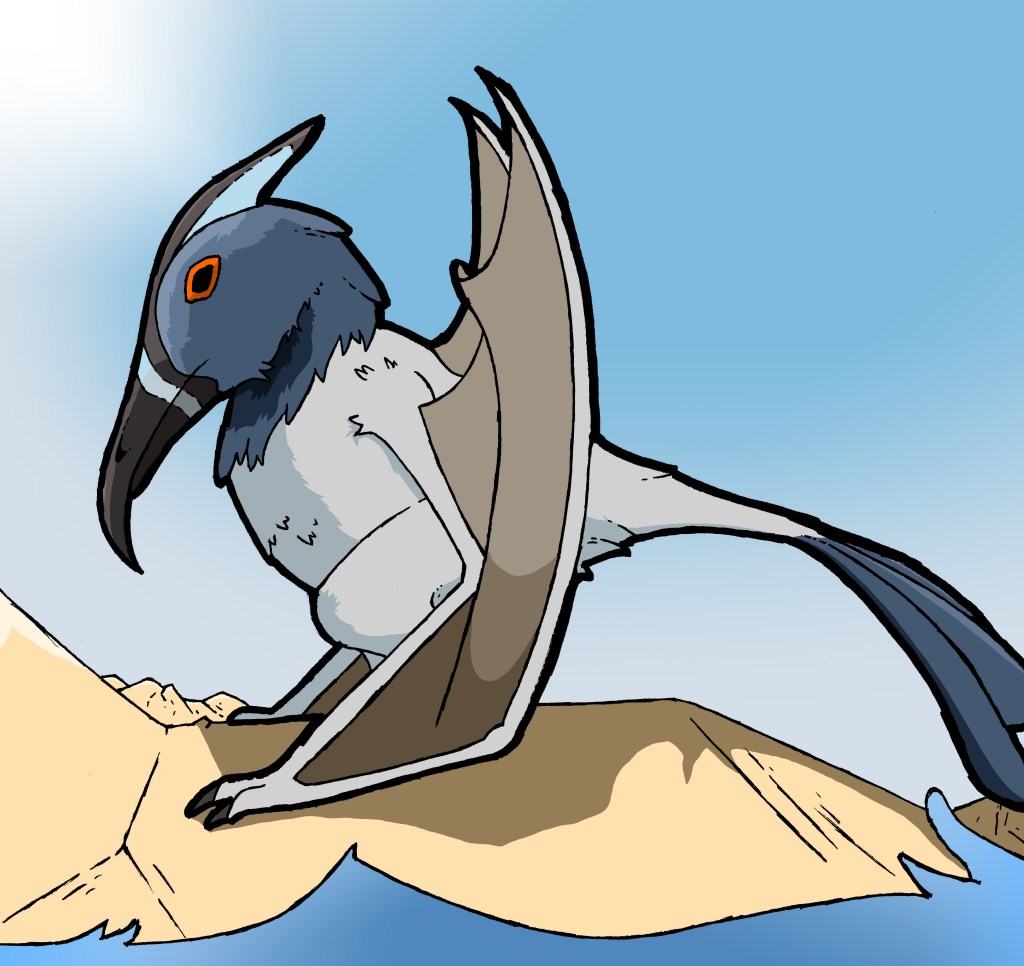
In the vibrant tapestry of Gaea’s wildlife, few creatures captivate as much as the Skimmer Drakes, a family of small to medium-sized wyverns adorned with dazzling feathers that shimmer in hues of blue, green, red, and beyond. These agile fliers grace the southern continents—Rioga’s steamy jungles, Atlantae’s karst-laden forests, and Southern Rhea’s diverse landscapes, including the arid western reaches of the Duganian Desert. Always found near freshwater rivers, streams, creeks, ponds, and lakes, Skimmer Drakes shun saltwater environments, carving out their niche in Gaea’s lush, water-rich ecosystems. Their name, derived from the Crested Skimmer Drake’s unique water-skimming hunting style, hints at the diversity and adaptability that make these wyverns a cornerstone of Gaea’s natural heritage.
Physical Characteristics
Skimmer Drakes are instantly recognizable by their large heads, disproportionate to their compact bodies, which lend them a distinctive silhouette against Gaea’s skies. Their feathers, a riot of colors from sapphire blues to fiery reds, serve as both a visual spectacle and a functional asset. The smallest species, the Arachni Spider Wyvern, measures a mere 10 centimeters, flitting through jungles with the agility of a darting insect. In contrast, the Crested Skimmer Drake stretches up to 50 centimeters, its robust form suited for gliding over desert waterways. Most species lack sexual dimorphism, but the Crested Skimmer Drake stands apart, with males boasting larger, more elaborate head crests that sweep back from their beaks, signaling strength and vitality.
Their wing structures vary by subfamily, tailored to their lifestyles. Crested Skimmer Drakes sport broad wings, ideal for gliding effortlessly over water surfaces to snatch prey. Pygmy Skimmer Drakes, however, have thinner, rounded wings, enabling quick, darting movements through dense vegetation. Wide-Winged Skimmer Drakes possess elongated wings that extend along their short tails, supported by two sets of tail bones, enhancing their gliding prowess between Atlantae’s karsts. One-clawed Skimmer Drakes feature a single grasping finger on their winged hands, perfect for snatching insects mid-flight. Their toothed beaks are equally specialized: the Crested Skimmer Drake’s hooked tip is designed to pluck fish from water, while Pygmy Skimmer Drakes have serrated edges for gripping insects. These feathers, often water-resistant for species like the Crested Skimmer Drake or insulating in cooler regions like Southern Rhea, underscore their adaptability across Gaea’s diverse climates.
Behavioral Traits and Social Structure
Skimmer Drakes are as fascinating in behavior as they are in appearance, with habits that reflect their solitary or social natures. Most, like the Crested Skimmer Drake, are solitary hunters, employing stealth and precision to capture prey. Picture a Crested Skimmer Drake hovering silently above a Duganian stream, its shadow barely rippling the water before it dives to skim a fish with its hooked beak. In contrast, several Pygmy Skimmer Drake species form flocks during hunts, their coordinated swoops overwhelming insect swarms in a dazzling display of teamwork—a rare social trait in this family.
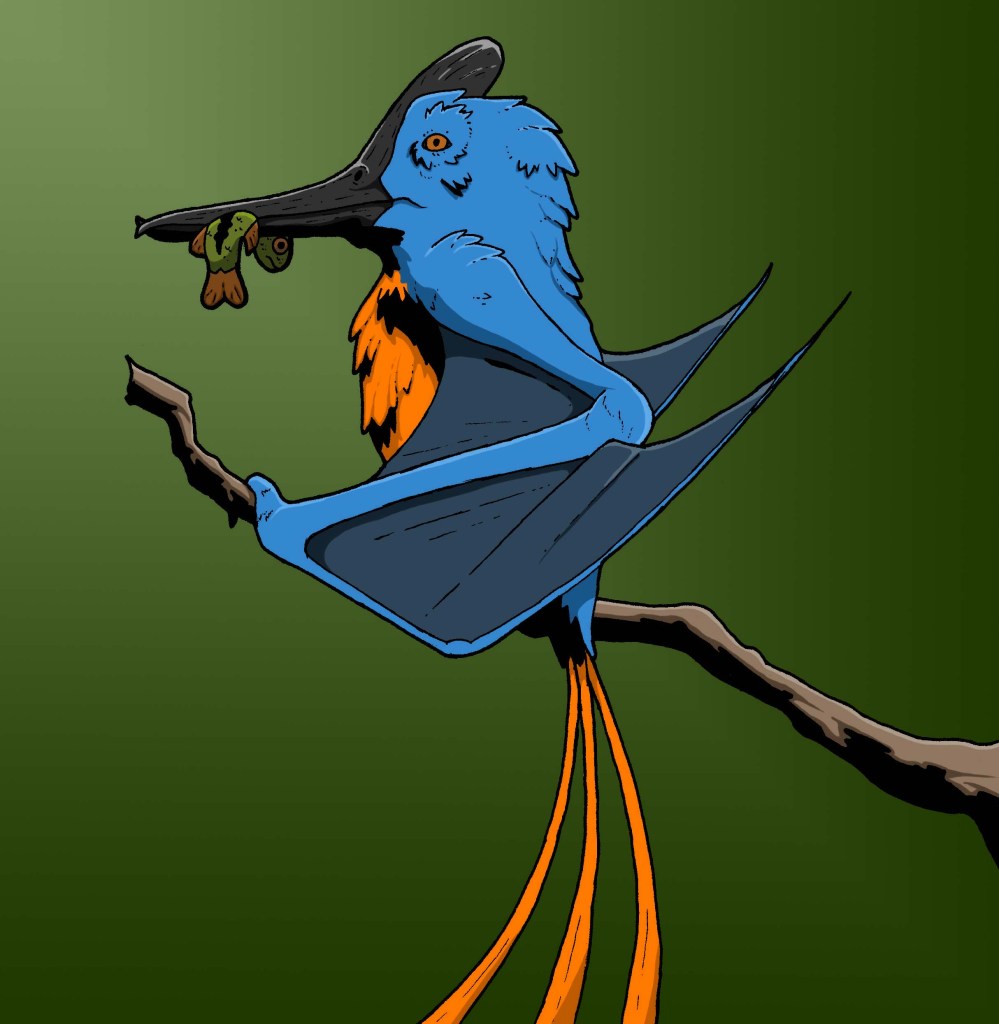
Mating rituals are a spectacle of color and skill. Males across species flaunt their vibrant plumage in spiraling aerial dances, their sharp, whistling calls echoing through forests and deserts. Some, particularly in Atlantae, offer freshly caught prey to females, proving their hunting prowess. These displays, often performed at dawn or dusk due to their crepuscular nature, highlight the males’ health and agility. Skimmer Drakes are fiercely territorial, especially during these twilight hours. They defend nesting sites with piercing calls and dramatic wing flares, engaging in aerial chases to ward off intruders. In the Duganian Desert, a Crested Skimmer Drake might spiral upward, its blue-orange feathers flashing, to deter rivals from a prime fishing spot, while Pygmy Skimmer Drakes in Arachni’s jungles use rapid, darting flights to protect their territory.
Ecological Role
Skimmer Drakes are vital cogs in Gaea’s ecosystems, balancing their roles as both predator and prey. As hunters, they regulate populations of insects, small reptiles, and fish, preventing overabundance that could disrupt their habitats. In Rioga’s jungles, Pygmy Skimmer Drakes keep insect swarms in check, while Crested Skimmer Drakes maintain fish populations in Duganian waterways. Their presence ensures ecological stability, but they are not without threats. Larger wyverns and predatory birds prey on both adults and their vulnerable nests, perched high in trees or on cliff faces. These nests, constructed from twigs, mud, and feathers, later serve as shelters for smaller animals when abandoned, extending the Drakes’ ecological impact beyond their lifetimes.
Adaptations to Their Environments
Skimmer Drakes’ success across Gaea’s southern continents stems from their remarkable adaptations. In the Duganian Desert, part of Southern Rhea, the Crested Skimmer Drake’s blue and orange coloration stands out against the arid landscape, yet its broad wings and hooked beak allow it to skim waterways with unmatched precision. The Arachni Spider Wyvern, native to Arachni’s jungles, blends seamlessly with its green and yellow feathers, darting through dense foliage to hunt. Wide-Winged Skimmer Drakes in Atlantae have evolved wings that extend along their tails, enabling graceful glides between karsts and trees. These adaptations highlight the family’s ability to thrive in environments as varied as humid jungles and arid deserts, always tethered to freshwater sources.
Life Cycle and Reproduction
Skimmer Drakes’ reproductive habits are as diverse as their habitats. Most species lay clutches of two to five eggs, though Pygmy Skimmer Drakes produce only one or two, prioritizing quality over quantity. Nests, built high in trees or on cliffs, are crafted from twigs, mud, and feathers to shield eggs from predators and harsh weather. Both parents share incubation duties over a three-week period, ensuring the eggs’ safety. Flaplings emerge ready to fly shortly after hatching, joining their parents on foraging trips. In some species, flaplings cling to their parents’ chests during early hunts, a behavior that protects them from predators. Lifespans vary: the tiny Arachni Spider Wyvern averages three years in the wild, while the robust Crested Skimmer Drake can live over ten years, with one captive individual recorded at nearly thirty years.
Conservation Status and Threats
While many Skimmer Drakes remain abundant across Gaea, some northern populations have suffered from the catastrophic climate shifts following the Downfall, a cataclysm 500 years ago that decimated 80% of sapient life. By year One-Hundred of the Fifth Era, encroaching frost pushed northern species southward, driving some, like Kato’s Skimmer Drake and the Northern Coastal Skimmer, to extinction. In Atlantae, efforts to preserve riverine habitats critical to Skimmer Drakes are underway, led by local tribes and scholars, but the ongoing environmental upheaval poses challenges. These losses underscore the fragility of even adaptable species in the face of Gaea’s changing climates.
Cultural Significance
Among the Elven tribes of Atlantae, Skimmer Drakes hold profound cultural significance, embodying the divine union of sea and sky in their religion centered on Fama and Yenisi. Each year, Elves gather along the Strait of Origin to witness flaplings take their first flights from cliffside nests, a ritual celebrating life and harmony. In Southern Rhea, including the Duganian Desert, Skimmer Drakes are respected for their resilience but lack the same spiritual weight, viewed as hardy survivors of the harsh landscape rather than sacred symbols. Their vibrant presence nonetheless inspires awe across these regions, a testament to their enduring appeal.
Expanded Taxonomy and Evolutionary Context
Skimmer Drakes belong to the Thrasher Wyvern order, alongside larger relatives like Fruitwings, Bee-beaks, and Glider-Wings. They are divided into four subfamilies: One-clawed Skimmer Drakes, with a single grasping finger for precise hunting; Wide-Winged Skimmer Drakes, whose extended wings reach their tails for enhanced gliding; Ground Skimmers, wingless foragers adept at navigating undergrowth; and Pygmy Skimmer Drakes, tiny at just an inch and a half. Their toothed beaks, a trait shared with Fruitwings, suggest a carnivorous ancestor, though only the Crested Skimmer Drake skims water surfaces, giving the family its name.
The Gaea Projects
Worlds Made For Everyone!
 The Gaea Projects
Leave a comment